
How Bench Warrants Work in Cherokee County
A bench warrant is a court order tied to an existing obligation. In Cherokee County, common triggers include missing a court or trial date, failing to appear after release on bond, violating a bond condition, or disobeying a judge's order. It may direct officers to bring the person before the issuing court.
A bench warrant does not itself create a new underlying charge. A traffic matter may stay with Cherokee Magistrate, a Gaffney Police citation belongs in Gaffney Municipal Court, and a felony case may later sit in General Sessions. The court listed on the docket controls the next appearance and recall question.
South Carolina Uses Bench Warrant
The local public term is usually bench warrant or failure to appear. The official state form is titled Bench Warrant After Failure to Appear. Cherokee County materials do not use capias pro fine as the main label for unpaid traffic or fine matters, so a reader should repeat the wording on the citation or docket when calling.
A missed bond appearance may also trigger forfeiture and a new warrant. The SCCA507A bond checklist warns that failure to appear can lead to an arrest warrant, loss of posted bond, and further charges in specified circumstances. The precise effect depends on the case and the judge's order.
Missed Court Dates in Cherokee County
If a Gaffney city case was missed, call Gaffney Municipal Court and ask whether the judge wants payment, a new date, a bond hearing, or a motion. A State Trooper or Cherokee Sheriff traffic ticket is handled through Cherokee Magistrate instead. Those offices do not share one reset counter.
For a county traffic matter, the traffic clerk can explain whether a ticket is delinquent and whether a court appearance is required. A phone search may not tell the whole story. Ask who will record the new setting and how the warrant recall will be confirmed.
Bench Warrant Issuance in Cherokee County
The judge directs the warrant after a missed appearance or other court failure. Rule 30 sets form and signature rules, and the order tells law enforcement to take the person before the issuing court. A lead-in image shows the rule's bench-warrant service instructions. Read South Carolina Criminal Practice Rule 30.
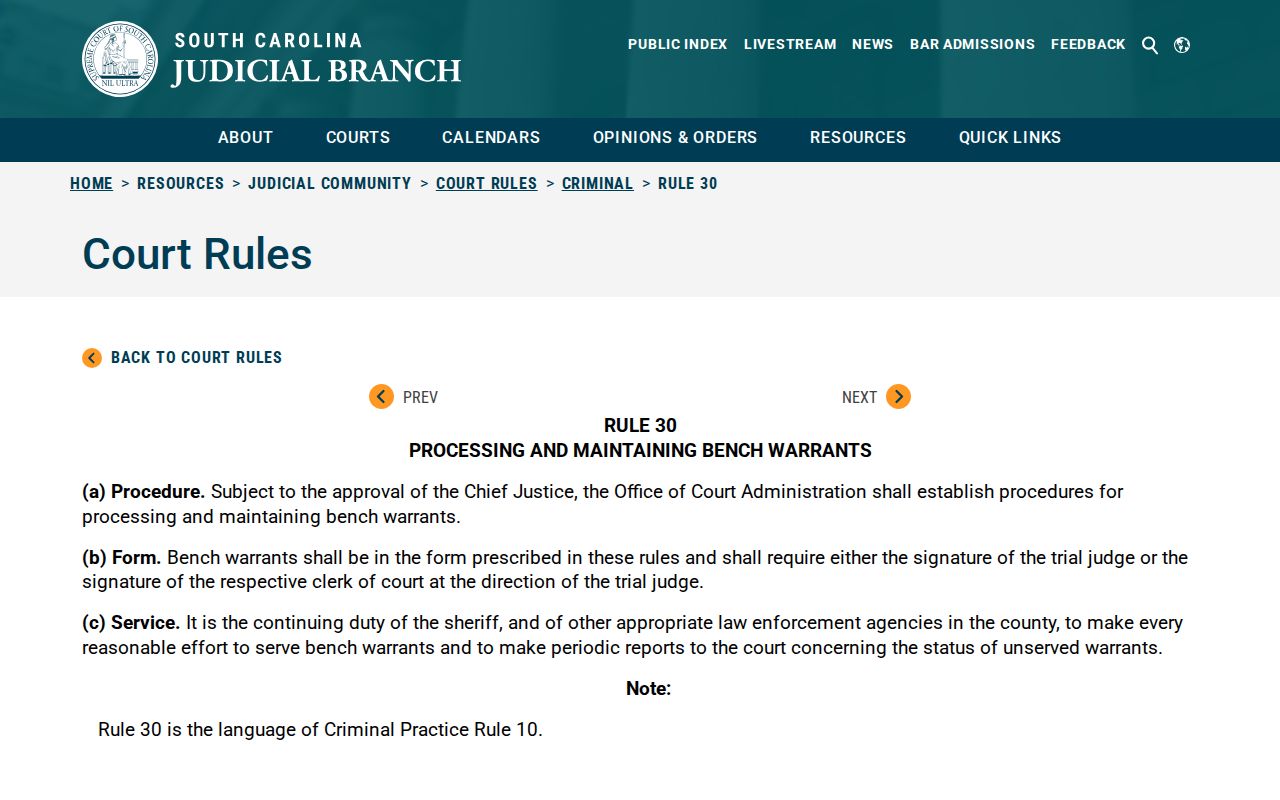
The rule places continuing service responsibility on the Sheriff and other appropriate law-enforcement agencies. The issuing clerk also keeps the case documents. Rule 3 separately directs relevant arrest-warrant and charging papers to the General Sessions Clerk when a summary-court matter moves up.
Rule 30 Service and Recall Trail
After issuance, the warrant moves through the court and the agency responsible for service. A returned warrant may show service or an attempt; a later signed order may withdraw it. Cherokee County publishes no single live service feed or update schedule. The safest confirmation is the issuing court's record plus a direct Sheriff question when service status matters.
A lead-in image links to the Cherokee County court roster search. Use the official roster portal to identify court information, then contact the issuing clerk about the order itself.
Roster data is a directory aid; it does not replace a case-specific warrant confirmation.
How Bench and Arrest Warrants Differ
Both orders can lead to custody, but their starting points differ. A bench warrant enforces an existing court duty; an arrest warrant follows a probable-cause presentation about an alleged offense. Cherokee County courts may see either type in connected records, so read the trigger and case number before asking about bond or the next hearing.
| Feature | Bench Warrant | Arrest Warrant |
|---|---|---|
| Trigger | Missed date, bond term, or court order | Officer presents probable-cause facts |
| Who issues | Judge or clerk at judge's direction | Authorized judge or magistrate |
| Case link | Usually an existing court case | Criminal allegation and affidavit |
| Next step | Ask the issuing court about date, bond, or recall | Confirm with court, counsel, and Sheriff |
Cherokee County Family Warrant Questions
Child-support and family enforcement matters use a different court route from a traffic ticket. Cherokee Family Court and the Child Support Office publish separate contacts, but no public warrant-search screen or local recall form was found for these matters. Contact the Family Court clerk or counsel named in the case rather than relying on a general traffic lookup.
A missed jury obligation is also a Clerk's Office question. The county's jury information directs jurors to the Clerk or Jury Line; no separate jury bench-warrant search is published. Tell the office whether the issue is a summons, a missed date, or a court order so it can route the call correctly.
Clearing a Bench Warrant in Cherokee County
Start with live confirmation, then follow the issuing judge's route. A bench warrant may call for a new date, an appearance, a bond decision, or a motion to recall. Cherokee County does not publish a universal recall form, and the Clerk's general $25 motion fee is not proof that every recall motion uses that fee.
- Use the Public Index or citation tool to locate the case, then call the issuing clerk.
- Ask whether counsel, a new date, bond, payment, or a motion is required.
- For General Sessions, contact the Clerk, Solicitor, or defense lawyer; do not use a traffic-court payment path.
- If the court directs surrender, confirm location, timing, booking, bond, and required identification first.
- Keep the order or receipt and ask when the docket and Sheriff record will update.
Caution: Do not assume an old fine payment or a blank online result withdrew the warrant; ask the issuing court for an order and updated status.
Gaffney Homeless Court and Bench Warrants
Gaffney's voluntary Homeless Court is a narrow local option for people who are homeless, formerly homeless, or at risk and are in treatment or transition. It considers qualifying city offenses and bench warrants carrying no more than 30 days. Domestic Violence 3rd Degree, DUI, and Driving with Unlawful Alcohol Concentration are excluded. It is not general county amnesty.
A lead-in image points to the city's program eligibility and court information. Review Gaffney's official Homeless Court terms and confirm the current date and eligibility with the city before relying on the program.
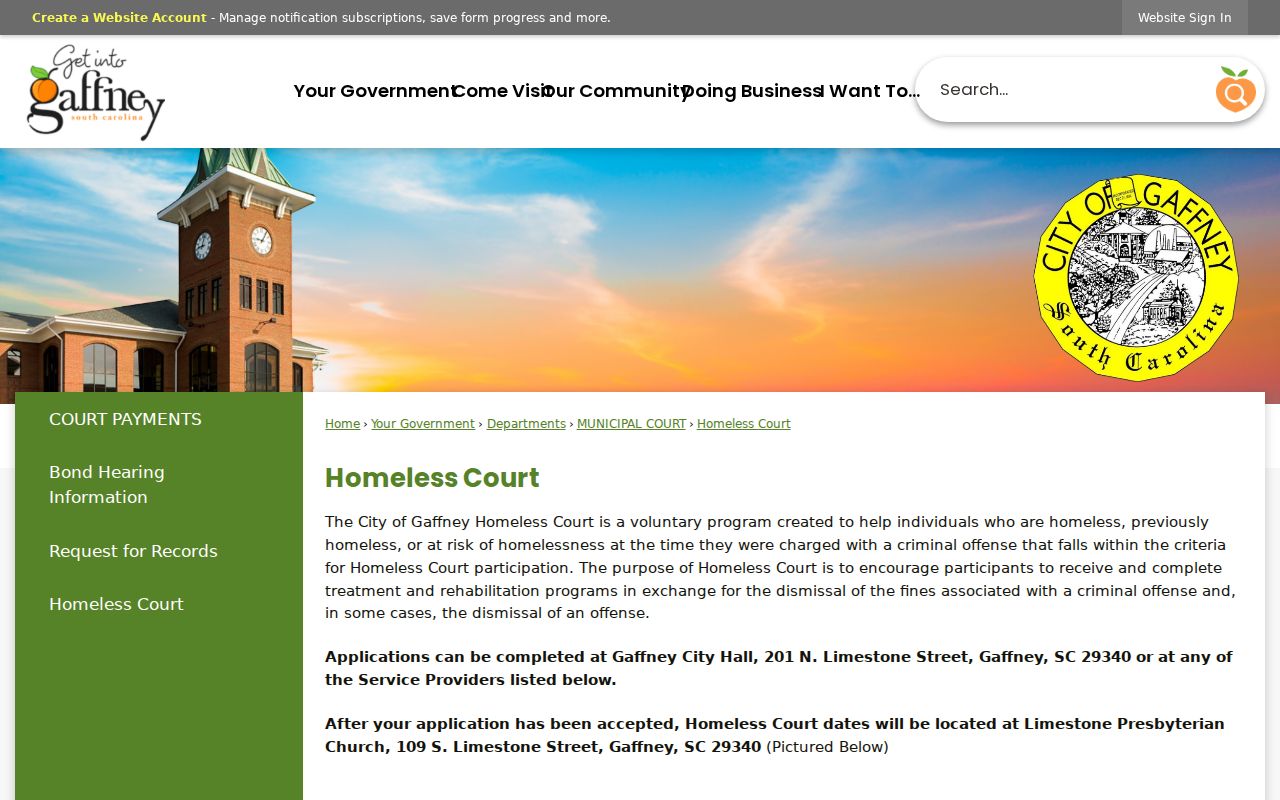
The program can address selected city cases through treatment and transition; it does not promise immediate release or cover other courts' warrants.
Cherokee County Courts That Issue Bench Warrants
Cherokee County matters may sit in General Sessions, Cherokee or Blacksburg Magistrate, Gaffney Municipal Court, Blacksburg Municipal Court, or Family Court. The citation or docket names the court that controls the warrant. A lead-in image links to the county courthouse page, which lists the Clerk and judicial offices. Open the official Cherokee courthouse directory.
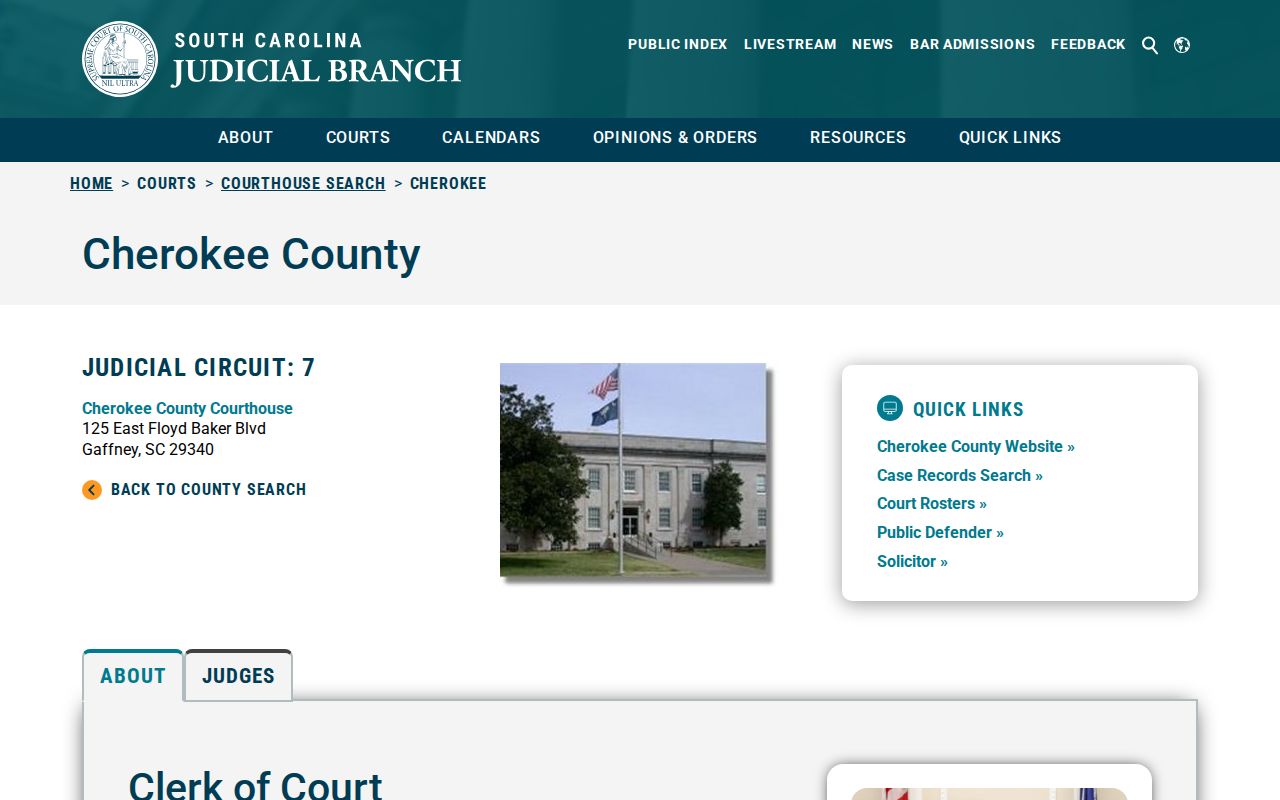
The courthouse image marks the General Sessions and Clerk route. A Gaffney city citation instead stays with its municipal court, while many State Trooper and Sheriff traffic tickets go to Cherokee Magistrate. Only the issuing judge or court can recall its own order.
For the full county check sequence, use Cherokee County warrant records to trace cases, tickets, court contacts, and Sheriff confirmation.